| System Menu | ||
|---|---|---|
 |
Chapter 2. Trace |  |
| System Menu | ||
|---|---|---|
| |
Chapter 2. Trace | |
Figure 2.33. System Menu
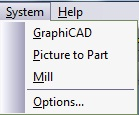
The System Menu enables you to work in different modules of the system simultaneously. The corresponding module button on the toolbar may be pressed to switch to that module.
Figure 2.34. form, Command tab

System Toolbars can be fully moved and customized. This allows
you to select and design the workspace, as you desire. The option
is unique to each toolbar. by clicking on Add or Remove Buttons option
on the toolbar you can view the list of existing buttons and whether
they are visible or not. Place a check mark next to toolbars you wish
to use.
![[Note]](../images/note.png) |
Note |
|---|---|
|
The toolbars themselves can be modified at all times. To change their position or shape within the module, simply drag or resize them according to your needs. Moving and resizing the toolbars does not require the use of the Customize Toolbar option. This option is only needed when you wish to modify the actual buttons on the toolbars. |
 |
Select from the menu to change the system defaults and parameters, and also to define the measuring method for your job. The Options parameters are set in the System Options dialog box. |
Figure 2.36. Trace form

| Default DPI | Enter the default DPI value for the File Open dialog box. This parameter defines the resolution of the picture file to be transferred to the module. |
| Reduce points tolerance | Enter the default tolerance value for the Reduce Points dialog box. |
| Minimal chain length | Enter the default length value for the Filter Short Chains dialog box. |
| Noise reduction factor | Enter the default noise reduction factor value for the Tracing Parameters dialog box. |
| Sharp corner detection | Enter the default sharp corner detection value for the Tracing Parameters dialog box. |
| Accuracy/Tension | Enter the default accuracy value for the Tracing Parameters dialog box. |
| AutoSnap / Angle Tolerance | Enter the default Angle Tolerance value for the Auto Snap dialog box. |
Figure 2.37. form
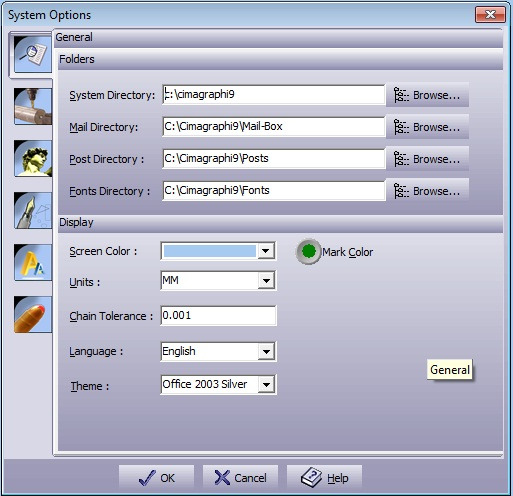
| System Directory | Defines the location of all the system files. This includes the executable files, DLL's, libraries, help files, and utility files. To change this directory, use the button on the right and point to a new directory. |
| Mail Directory | Defines the location of all the temporary files, including the private clipboard files, backup files and temporary files. To change this directory, use the button on the right and point to a new directory. |
| Posts Directory | Defines the location of all the machine drivers. This includes the provided post-processors. To change this directory, use the button on the right and point to a new directory. |
| Fonts Directory | Defines the location of all the fonts provided with the system. The system will automatically detect the Microsoft Windows™-provided True-Type fonts or any other True-Type font properly installed in Windows™. To change this directory, use the button on the right and point to a new directory. |
| Screen Color | Select the preferred background color. |
| Units | Set the work-mode units (mm or inch). |
| Language | Select the language of the system. |
| Chain Tolerance | Define the system wide size for chaining. This value defines the smallest gap to be automatically closed by the system. |
| Theme |
Define the Theme the system will use for display
appearance. |
| |
 |
|
| Layers Menu |  |
Help Menu |